



Why does China need autonomous development of its environment?
“White cat, black cat, the important thing is that it catches mice.
Deng Xiaoping, 1962.1
From the formulation of these words, Chinese political pragmatism has taken the Asian giant far on its path to recovery from the catastrophic ‘Century of Humiliation’. Despite this, China finds itself in a difficult situation to resolve: its solitary existence as the only giant in its strategic circle. This, which in any other context could be understood as an advantage for any power trying to forge its way toward hegemony, for Chinese diplomatic doctrine, based more on cooperation than tutelage, seems to present itself as a problem to be addressed.
The United States still casts a long shadow over Asia, and the forces that claim to be its allies are firmly gripping a region that accounts for 60% of the world's population2, 371.3% of global GDP3, and sufficient material resources to determine the course of the present and future.4 This is considered the first pillar that supports the issue of the Asian takeoff as a center of power in international politics. Despite being - in numerical, geopolitical, and material terms - the most important region in the world,5 This is found by the complex strategic board that is characteristic of it.
Asia is an enormously diverse space, both in the states that compose it and in its geographical size. While one could delve extensively into the political details and peculiarities of the region, for the sake of the argument of this article, the continent's strategic environment can be summarized into three groups differentiated from each other by their approach to international politics and the prior history that serves as their platform.
On one hand, possibly forming the largest and most robust group in terms of geopolitical-strategic power, is the network of US alliances led primarily by South Korea, Japan, Turkey, Saudi Arabia, and India. On the other hand, Russia, North Korea, Iran, and China itself are seen as a bloc confronting the former in both local and global interests. Finally, a heterogeneous group, barely recognizable as united, consists of the remaining countries on the continent. These, with strategies independent of the previous two groups, and balancing their stance with respect to them based on their security needs, include among their most prominent members Pakistan, the ASEAN countries,6 and the Turkic and Arab countries of Central Asia and the Middle East.
This partition of the continent does not intend to assume that the region is in a geopolitical situation adapted from “Clash of Civilizations” as proposed by Huntington.7, but rather to group the vast majority of Asian state entities around their strategic goals and the means they draw upon according to their individual loyalties to one power or another. The first group, for example, organized around the pursuit of US interests, NATO, or the QUAD8 Its main objective is to counter Chinese claims on the mainland and any potential expansion they might undertake into the ocean, even beyond the South China Sea.9 This is achieved by obstructing China's Belt and Road and String of Pearls mega-projects,10 which allows for relatively stable control over the economy and military sphere of the region and its surroundings.11 Given that Japan and South Korea act as the main instruments of American containment against China's maritime advances, and India plays a similar role in the continental sphere, a tense calm is maintained whose peaceful resolution is becoming increasingly complex.
The second aim is to question the United States as the guarantor of continental and global security, thus challenging its presence throughout the territory. While there is no established joint alliance led by China, states that share the aforementioned goals orbit around its strategic decisions. This phenomenon can be observed in China's material and ideological support for states that have faced various economic and military crises in the last decade; examples include support for Russia in the context of the invasion of Ukraine or recent support for Iran in what has been dubbed the “12-Day War.” The means for this questioning are primarily two areas. Firstly, technological superiority, well-supplied by the Asian giant's unstoppable industry. Secondly, strategic-technical supremacy, characterized by a constant struggle that, until now, remains in balance, both on the economic front—due to the fluctuating development of the Belt and Road Initiative—and on the military front, due to strategic advances and withdrawals of forces in key points such as Kashmir, the Strait of Malacca, the Himalayas, or Taiwan.
Finally, the third group, and the most relevant for this article, is the amalgam of states that, from Southeast Asia to the Middle East, form a kind of renewed Non-Aligned Movement in relation to Sino-American issues. However, this does not mean they are oblivious to their surroundings. Their common goal is the relative maintenance of a status quo of autonomy with respect to both powers, and to enhance their economic development by benefiting from the outcomes of such complicated relations.12 The accession of Central Asian countries to the Belt and Road Initiative or the shifting trade position of ASEAN, by intermittently prioritizing the United States or China as economic partners, are evidence of this and the means by which these countries achieve their goals.13
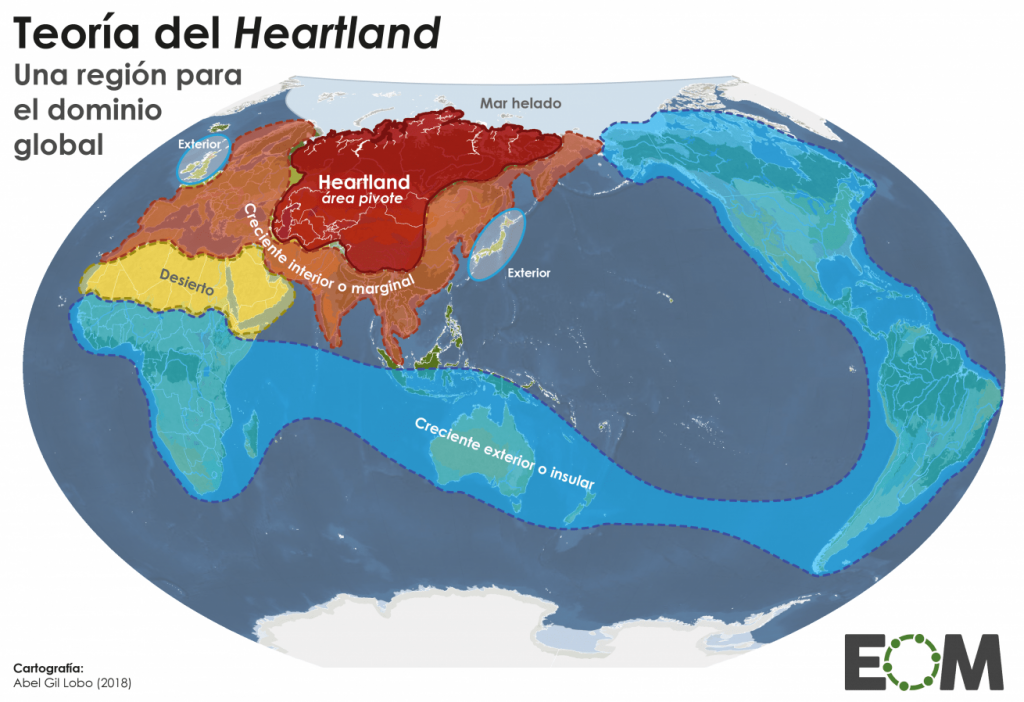
“Whoever rules the Heartland will rule the World-Island; whoever rules the World-Island will control the planet.”,14 the geographer Halford Mackinder stated when formulating his Heartland theory. This theory highlights the importance of controlling Asia, identified as the World-Island, to secure a power's leadership and preeminence over the rest. This leadership would not only apply to the continent but also to Europe as an extension and the world as the ultimate goal. The current problem of China's control over this world-island is precisely its fragmentation, which prevents the establishment of a single hegemonic power in the region explicitly, as other actors still project their power.
Certainly, there are different perspectives and opinions regarding the understanding of Chinese intentions since the country became the second global power. These range from those who see the Asian giant as an imperialist successor to Western powers, displacing them wherever it goes, to more idealistic viewpoints that present it as a force for peaceful change, distancing itself from neocolonialism. It would be a mistake not to understand China as a state intrinsically connected to its extra-border interests, but it is also safe to say that its methods are not those of traditional imperialism to which international relations are accustomed.
China's objective is to consolidate a much broader strategic environment than it currently enjoys, primarily by engaging undecided actors in the region. Some progress has already been made in this direction, such as smoothing over past tensions with ASEAN, which could allow for greater maneuverability and operational space in the Pacific, even bypassing the Taiwanese issue in the process. This includes multilateral agreements reached for opening commercial ports in the Indian Ocean or establishing logistical hubs across the continent from Beijing to Europe.
Slowly but surely, these strategies are paying off and allowing China to consolidate a key element for its triumph on its path toward global hegemony: the autonomous development of its environment. The gradual displacement of the United States from the region as the main strategic and commercial partner, beyond its most loyal allies, has propelled the first domino piece that China needs for the 21st century to be the “Century of Asia.” This first piece is a continent where first-rate development and cooperation occur among local actors with decreasing influence from foreign powers. Through this, the possibility is observed that China could lead a multipolar international landscape without the need for military intervention, even possessing the capabilities to carry it out.
Ultimately, the issue with the “Asian Century” does not lie in the continent's inability to assume a predominant role in geopolitical developments. This is a phenomenon that, despite obstacles, is already occurring. The problem lies in the region's fragmentation and the resulting imbalance in state development that this creates among its constituent actors. China has been able to interpret the strategies proposed throughout history to assume leadership and has decided to forge its own path towards it. The novelty that the Asian country proposes is to take a path to leadership that is not based on warmongering or neo-colonial actions, but on cooperation and development to achieve its medium and long-term strategic goals.
quotes
ASEAN.
Quad.
10 Terrestrial and maritime branches of the “Belt and Road Initiative” respectively.
11 Ibid.
14 Mackinder, H. J. (2020). Democratic ideals and reality: A study in the politics of reconstruction. Cosimo Classics.