

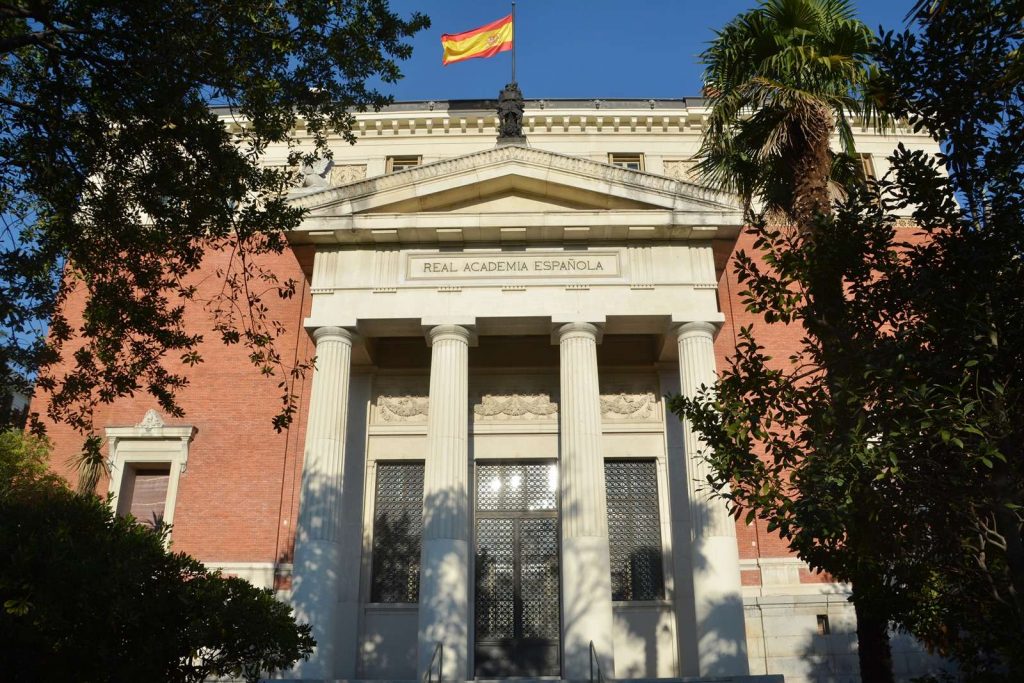

In the words of Don Quixote, “He who reads a lot and travels a lot, sees a lot and knows a lot.”1, an idea that reaches greater depth upon recognizing Miguel de Cervantes as the best ambassador for the Spanish language in the world. In this idea lies the key to the success of this Romance language that has traversed the globe hand in hand with the legal instruments of Francisco de Vitoria or Fray Bartolomé de las Casas, the literature of Rosalía de Castro or Federico García Lorca, and the religion of Saint Francis Xavier or Saint Ignatius of Loyola.
Spanish is the second most spoken language in the world after Mandarin Chinese, the second most used language on the internet, and the third in business communication. It has 500 million native speakers and 100 million more fluent speakers.2 However, of these Spanish speakers, only 49 are located in Spain—the language’s birthplace—while the Americas account for the remaining majority, with pockets in Equatorial Guinea and the Philippines. The case of the United States is particularly noteworthy, where, according to the United Nations, 17.1% of the population will be Spanish-speaking by 2050. The demographic and geographic factors of Spanish are the first factors to mention when considering its global influence.
Joseph Nye defined soft power as the ability of an international actor to influence others through attraction and persuasion rather than coercion or payment.3 Following this idea, Spanish can be considered Spain's best instrument of influence. It is the medium for renowned and internationally successful films such as Belle Époque, The Discreet Charm of the Bourgeoisie, or, more recently, Society of the Snow. It is the birthplace of writers, philosophers, painters, and historical figures of the caliber of the Catholic Monarchs, Bernardo de Cólogan, or Salvador de Madariaga. All of them carry this language as a symbol of representation and connection with other regions of the world.
On the other hand, Spanish is an economic asset. 10% of global GDP comes from sources related to the language, either through the industry itself or because the Spanish-speaking population accounts for 16% of total wealth.4
Likewise, it is a source of power in interstate relations, with Spanish being an official language in major international organizations such as the United Nations, the Organization of American States, the African Union, and, as of 2024, the Hague Conference on Private International Law. This latter point is crucial when observing that one-third of the International Court of Justice's litigation involves parties who speak Spanish and must communicate in English or French—the institution's only official languages—thus relegating their native tongue to a secondary role.
This shows that while Spanish has a strong global presence, it still has a long way to go. This path goes hand in hand with the growing influence of the Global South on the international agenda. What Niall Ferguson described as “The West and the Rest”5 has been left behind to make way for a region composed of Latin American and Caribbean countries, Africa, and the Middle East, which will impose its discourse on the world, this being a discourse in Spanish.
The United States still casts a long shadow over Asia, and the grip exerted by its allies firmly holds a region that accounts for 60% of the world’s population, 37% of global GDP, and material resources sufficient to shape the course of the present and the future. This is considered the first pillar underpinning the issue of Asia’s rise as a center of power in international politics. Despite being—in numerical, geopolitical, and material terms—the most important region in the world, it is shaped by the complex strategic landscape that characterizes it.
The true benefactor of the Spanish language's power is none other than the country where it was born and from which it spread: Spain. Beyond the virtues that arise from the use of this language by Spaniards, the most significant international factor corresponds to the innate and close bond with Spanish America. To refer to this region, terms such as Latin America, South America, or the Caribbean could be used, but speaking of Spanish America introduces the link between Spain and this region, which has survived threats like the Black Legend or political fluctuations, and that link is none other than a common language.
This fact has many implications, both positive and negative. First, the common language fosters a binational community that spans two continents and comprises 600 million people, along with a diverse array of joint initiatives, institutions, and programs. It is no coincidence that Spain is the leading investor in Latin America and the largest donor of Official Development Assistance (ODA) to the region.6 In turn, Spain is the gateway for these countries to the European Union, advocating for the signing of the EU-Mercosur agreement in 2023 and for the EU-CELAC summits.
Second, Spain is a destination for Latin Americans, who in 2024 accounted for 6.51% of the foreign population,7 mostly from Colombia and Venezuela. In this case, one-way migration presents both challenges and opportunities for the European country. On the one hand, Spain is facing a demographic crisis that can only be resolved by the arrival of young people who contribute to the birth rate, the workforce, and the revitalization of a struggling economy. On the other hand, migratory movements are putting institutional structures to the test as they must cope with the massive influx of foreigners. These challenges range from hate crimes related to racism and xenophobia—which increased by 211% in 20238– until the institutional support of a Social Security system that sees its number of applicants increase. Similarly, the common language also implies family ties that, supported by Spanish legislation, facilitate obtaining nationality, residence and work permits, and the acquisition of housing.
For all these reasons, when analyzing the relationships between both territories, we don't just talk about a common language, but about values, culture, and a shared past that unites these two regions and makes it impossible to think of Spain without Hispanoamerica and vice versa. Nevertheless, the current challenges that sustain a discourse of separation, thus rejecting the bond of two parts that are stronger together, cannot be ignored.
The richness of Spanish is incalculable, and it is magnified when mentioning the Iberian Peninsula. Just as Spain set sail beyond the Atlantic, so did Portugal, and thus the Ibero-American community was born.
800 million people, 30 countries across all continents, and 10.1% of the global population share the only two languages in the world that are mutually intelligible. Spanish and Portuguese are sister languages that can be easily understood and learned, thus creating the world’s largest linguistic community; for while Mandarin Chinese is spoken by more than 1.4 billion people, these are confined within the country’s borders. Spanish and Portuguese, on the other hand, are officially spoken in 22 countries in the Americas—both South and North—as well as in Angola, Mozambique, and Equatorial Guinea in Africa, and in East Timor in Asia.
This unique power in the world has been harnessed with the creation of the Ibero-American Summits, which since 1991 have brought together Ibero-American countries and Andorra. The next summit will be held in Madrid in 2026. It is worth noting that governmental advances coincide with advances in civil society, which observe how sharing two such similar languages is an advantage for those who use it. Consequently, the first Ibero-phone universities have been inaugurated, such as the Universidade Internacional do Cuanza in Angola or the Universidad de La Romana in the Dominican Republic.
Similarly, in 2021 in the Canary Islands, the geographical midpoint between both regions, the first summit with Spanish- and Portuguese-speaking countries was held with the aim of creating a pan-Iberian space. A common ground where the benefits of this geographical, economic, and above all, linguistic connection can be exploited, strengthening their influence in the European Union or the African Union, among others.
However, this bond is not free from inequalities stemming from the field of education. The native Portuguese speaker understands Spanish almost perfectly, while variations must be made for them to be understood by the Spanish speaker. This is how "Portuñol" was born. The richness of language is such that a new language can be created to facilitate communication between people separated by different pronunciations. This reinforces the role of educational centers, which can create linguistic unity for 800 million people in a short time. Therefore, betting on innovation and education is betting on the greatness of a language with no limits and with great future prospects.
Spanish is power, and its global interest is proof of that. First, because even though we are aware of its complexity and broad lexical richness, it is a language that writes what it says and reads what it writes; second, because it represents the universal civilization of a great empire; and finally, it is a transmission of values and humanity.
However, if language was historically thought of as a vector of soft power, this balance is now shifting, as demonstrated by English. This language dominates the world by becoming hard power by imposing Anglo-Saxon thought; it does so in the economy, in the values it transmits through its culture, and by relegating languages like Spanish, which has a greater geographical spread and number of speakers, to the background.
Even in the 15th century, historian Juan de Valdés declared that “The language that needed to be reclaimed is the language that was spoken”,referring to Spanish. More than five centuries later, Spanish remains the language that is spoken. It is important to defend a language that is soft power, but can become hard power. Likewise, it is important to defend the values it represents, the civilization it builds, and the empire it recalls because, ultimately, Macondo is no longer Colombian territory and Don Quixote is no longer a Castilian hidalgo. Thanks to the power of Spanish, Macondo is now a universal place and Don Quixote an exemplary knight.
quotes
Miguel de Cervantes Saavedra. Don Quixote de la Mancha (Ed. Francisco Rico, 2nd ed., Vol. I, chap. XXV). Espasa, 2004.
2 Instituto Cervantes, El español en el mundo. Anuario del Instituto Cervantes 2024 (Madrid: Instituto Cervantes, 2024), 652 pp.
3 Joseph S. Nye, Soft Power: The Means to Success in World Politics. (PublicAffairs, 2004).
4 Cervantes Institute, Spanish in the World. Cervantes Institute Yearbook 2024 (Madrid: Cervantes Institute, 2024), 652 pp.
Niall Ferguson, Civilization: The West and the Rest (Penguin Press, 2011).
6 ICEX-Invest in Spain & Ibero-American General Secretariat. (2024). Global LATAM Report 2024 (VI ed.). Spain: ICEX-Invest in Spain.
7 National Statistics Institute (INE), Demography of Spain: Continuous Population Statistics, 2024.
8 Ministry of the Interior, Report on the Evolution of Hate Crimes in Spain 2023 (Ministry of the Interior, 2024)