






The consequences of Brexit on EU citizens living in the United Kingdom
On the 23rd of June 2016, 52% of British citizens chose “Leave the European Union” when asked2: “Should the United Kingdom remain a member of the European Union or leave the European Union?”.
Now, almost ten years after the referendum, opinions have slightly shifted. According to a YouGov poll from June 2025, 56% think it was wrong to leave the EU.3 Nevertheless, Brexit has now been enacted and it is unlikely that the UK will re-apply for EU membership in the near future. As it is, Great Britain rejected EU membership and British people lost EU citizenship.
However there are still EU citizens living in the UK. In a 2021-2022 census, it is estimated
that 5.3 million EU passport holders are living in the UK.4 The British government implemented what is referred to as the European Union Settlement Scheme, or EUSS, an application to continue living and working in the UK. It stated that EU citizens living in the UK before January 2021 would be unaffected. In spite of it, backlogs appeared in the process and have been raveling EU citizens’ lives.
A brief history of European immigration to the United Kingdom
Where does EU immigration to the UK originate? European immigration to the UK started even before the creation of the EU. In the years prior to World War II, minorities persecuted by the Nazi regime fled to Britain. Estimates stand that 160,000 Polish refugees5 and 80,000 Jewish refugees6 reached the UK. After the war, it welcomed workers from Soviet territories in order to ensure an industrial workforce. These workers, mainly from Poland and Ukraine, were necessary to boost those industries in order to push economic recovery after the war.
Most of these immigrants settled permanently7 and constituted the first waves of contemporary European immigration to the UK.
But the country’s accession to the European Community marked a turning point for its history of European migration. After two failed attempts, the UK joined the European Economic Community in 1973. The European Union was created twenty years after, in 1993. This status of member state had eased immigration, particularly due to the right of free movement guaranteed by European law. It meant that all EU citizens and their close family members had the right to move and reside freely within the EU (the UK included, prior to the referendum), a fundamental right established by Article 21 of the T reaty on the functioning of the European Union and Article 45 of the EU Charter of Fundamental Rights.
The expansion of the European Union in 2004 to central and eastern Europe, Malta, and Cyprus created more migration movement into the UK than in other member states. Indeed, the UK, in need of labor, did not set a quota when other member states imposed stricter transitional restrictions on workers from the new member states.8 It resulted in significant numbers of migrants, particularly from Poland, notably larger than the government had anticipated.9 Therefore when Romania and Bulgaria joined in 2007, the government, now more aware of the scale of the arrivals, limited immigration to self-employed, high-skilled workers in specific sectors, as well as students.10
However, European immigration to the UK has not solely been characterized by constant arrivals. Numbers reveal that in 2009, more workers from the new EU states left the UK than arrived: 45,000 arrivals against 57,000 departures.11 EU immigration truly declined after 2016. According to the Migration Observatory at the university of Oxford, this can be explained by the decrease of the pound’s value after Brexit, easier employment in Southern Europe, and a negative perception of the UK as a place to live. Net migration of EU citizens became negative after 2021.12
Brexit referendum and the creation of the European Union Settlement Scheme
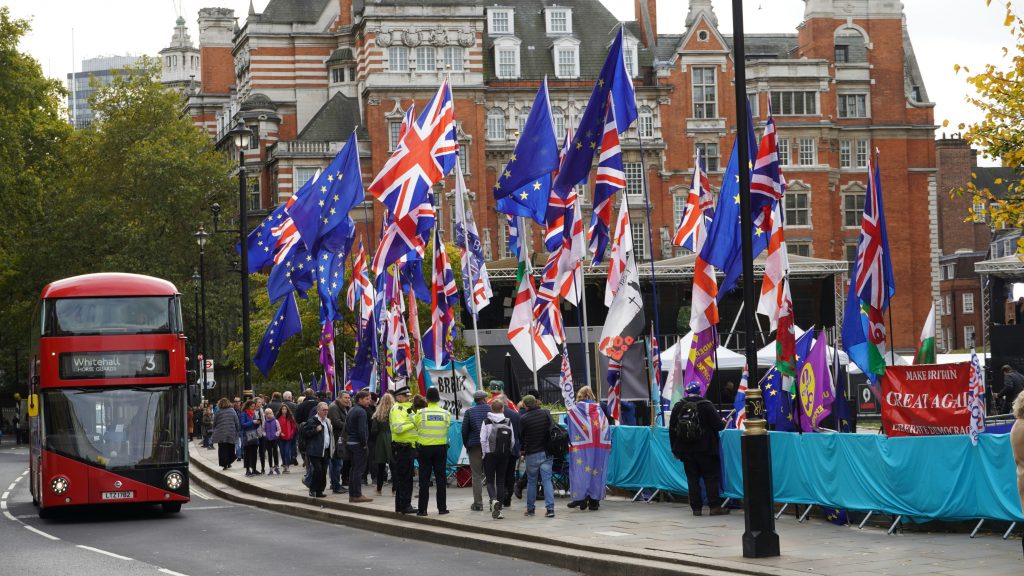
In July 2016, 63.7 million people lived in the UK. 8% were non-British and about half of those were from Europe.13 These numbers highlight a non-British immigrant population, which, although significant, remains relatively small. However by choosing to leave, Brexit tried to further push back against new arrivals of migrants. One of the main ideas voiced during the referendum’s campaign was to «tak[e] back control of our borders» and thus have more control over immigration.14 Therefore, free-movement became an important political point and was abolished with the UK’s departure. As a solution for EU nationals living in the UK, a motion in the House of Commons was passed demanding the guarantee of their rights.
Since January 2021, a residence permit has been required to live in the UK, with more flexible requirements for EU citizens who were established there for long enough. A work permit is also required for new arrivals. The complete abolition of free movement vis-à-vis the EU occurred in April 2025. In addition to a valid passport, EU citizens are now required to have an Electronic Travel Authorization, or ETA, to travel to the UK for less than six months.
Thus, after the Withdrawal Agreement, it became mandatory to regularise the status of EU citizens who had been living and working in the UK for a long time. This concerned not only EU nationals but also the European Economic Area, or EEA, citizens (Norway, Iceland, Liechtenstein) and Swiss nationals, all of whom’s rights were protected under the Withdrawal Agreement. This urgent need was organised around the European Union Settlement Scheme, or EUSS. The EUSS was created by the UK government in order to allow EU citizens to reside in the country. Although the UK left the EU on 31 January 2020, a transitional period was implemented, where most EU law still applied to the UK until 31 December 2020. After that date, any EU citizens willing to live and work in the UK had to meet the domestic immigration system’s criteria. In the meantime, the residence status of EU citizens in the UK was supposed to be protected under the Withdrawal Agreement, through an application to the EUSS. The deadline to apply to the EUSS was therefore set for the 30th of June 2021. For those who missed the deadline, they were still able to apply after that date, in case of exceptional circumstances.
By December 2025, the EUSS had received 8.78 million applications, significantly higher than the 3.8 million citizens living in the UK, according to the 2021-2022 census. This is explained by the fact that some applied more than once. T o those, over 2.7 million applications have been added after the 30th June 2021 deadline, through the late application process, repeat applications, joining family members or derivative rights applications.15 This massive number of applications has and continues to be a source of risk, since it concerns authorization to continue living one’s life in the UK. Among the applicants, many have found themselves in difficult and constrained situations in their daily lives.
The European Union Settlement Scheme implemented: an administrative quagmire
for EU citizens
The EUSS was conceived to facilitate the regularization of the status of EU nationals in the UK. Nonetheless, the Scheme by being an online process lacked the capacity to adapt to vulnerable individuals and cases, and therefore it penalised those who encountered difficulties in the process, rendering them undocumented despite having lived in the UK for years.
Moreover, the government rushed to digitize the immigration system by December 2024, but the implementation has complicated the process in addition to suddenly having to create eVisas for around 4 million people. Therefore, it created two main issues: the EUSS failed in its role of protecting the rights guaranteed by the Withdrawal Agreement, and the accelerated digitalization process exacerbated the initial issue.
The Withdrawal Agreement has been a legal support to protect EU citizens’ rights. The EUSS became the tool that was supposed to substantiate this legal guarantee. However the government didn’t consider EUSS status to be enough to beneficiate Withdrawal Agreement rights. A second obstacle stems from the fact that in 2024, there were 137,000 applications awaiting a decision, complicating administrative procedures for many and consequently their lives in the UK. Besides, those waiting for a decision, who submitted a complete EUSS application, do not have their rights protected and live without even a temporary guarantee of their rights. Finally, this system is detrimental to a large number of people. Some are not aware that they need to complete an application for the EUSS, while others are completely unaware of its existence.
Indeed, certain groups of people have been especially badly affected by the transition. On one hand, vulnerable individuals such as children (an estimated 966,000 children under the age of 18 in 2017), those under guardianship, or the elderly (an estimated 61,600 EU citizens age 75 or older), are often unable to manage administrative matters and must rely on their relatives to secure their legal status. On the other hand, at-risk persons such as victims of abuse (an estimated 87,000 EU citizens victims of domestic abuse) and those hospitalized, find themselves in situations of great distress, which legal status issues only exacerbate.16 Those groups find themselves caught in administrative limbo and incurring significant expenses due to their irregular status. This helps understand the risks involved in such a sudden and hurried change.
Secondly, the acceleration of the digitalization process has complicated the procedure for many EU citizens. The end of all physical forms of regularization of status from December 31, 2024, coinciding with the creation of the ETA, has been a source of difficulty and uncertainty, particularly at a time when some of these citizens were outside the UK for the holiday season. This means that 4 million people suddenly had to switch to an eVisa. Furthermore, this doesn’t take into account the technical difficulties faced by the Home Office’s databases and website.17 This digitalization has marginalized older people, who have found themselves in a difficult position, forced to navigate online processes that are completely unfamiliar to them.18
However, this needs to be put into perspective. These problems, although marginalizing for some, do not apply to all EUSS candidates. In December 2025, the Ministry of Foreign Affairs stated that 6.4 million individuals had applied to the EUSS. Out of these, 5.8 million had received a status (4.43 million settled, 1.38 million pre-settled statuses).19 Nevertheless, the various obstacles mentioned above are causing distress for European nationals who find themselves even more marginalized. According to the 3 Million support group, during this process, tens of thousands of people have lost their jobs, employment or educational opportunities, their homes, or even the right to return to the UK after travels.
Rise of nationalism, decrease of immigration, and support groups: What can be expected in the future?
Although promises were made during the referendum, the government has encountered
difficulties and the implementation of Brexit has left some EU nationals to fend for
themselves in the face of administrative hurdles. But beyond that, it appears that the struggles of EU nationals have not been Brexit’s priority. The government initially had to deal with not only the referendum negotiations, but also several other urgent situations, particularly those of a diplomatic nature, such as the Irish border or tensions with France’s fishing areas. Moreover the protection of EU nationals was not a priority given Brexit was conceived as a
nationalist movement advocating for a rejection of immigration and immigrants. Complicating the change of status and leaving areas of legal ambiguity were processes that aligned with Brexit’s goals and might have discouraged people from remaining in the UK. Whether it was intentional or not, the government has shown signs that immigrants are no longer welcome, which is what Brexit was aiming for.
These nationals thus got caught in the crossfire, between the rejection of the EU and the rejection of immigration, facing attacks on both fronts. Besides, by not being British citizens, they are increasingly overlooked and marginalized by the government. Their influence on political life is minimal, and their struggle carries less weight because they are a minority within the minority of immigrants residing in the UK.
EU nationals found themselves trapped in difficulties securing their status and their rights. In the case of those awaiting a decision, when leaving the UK for a family emergency, funeral or for work, they risk being refused entry into the territory while their case is being processed.21 With an important number of applications22 backlogs appeared in the processing of those.23 The waiting time to receive an EUSS decision could range from less than a month (52, 59%) to 2 years in some rarer cases (0,37%).24
Accordingly, Brexit has influenced European immigration to the UK. Arrivals have become less frequent. The year before the referendum, immigration rose to 189,000. In June 2017, it decreased to 103,000, and then 74,000 in June 2018.25 The closure of borders and the end of free movement have limited migration and altered the attractiveness of the country, making it more complex and less attainable.
In short, the future of European migration in the UK seems compromised, especially as the British political situation appears increasingly complex. Even though Brexit has lost most of its support, with the rise of British nationalism, one can’t help but question the fate of EU nationals in the UK. Nigel Farage, a key figure in the Brexit campaign, and his party Reform UK, are gaining popularity. According to a January 2026 Ipsos poll, voting intentions for the general elections in favor of Reform stand at 30%, which would secure them a plurality. As stated on the party’s website, of the 19 main points of their policy, more than 8 are based on the rejection of both immigration and the EU. However, the recent victory of Hannah Spencer from the Green Party in the Manchester by-election sparked hope. The Labour Party (the current government), which has been heavily criticized for its handling of the immigration issue, came in third place close behind Reform. The Green Party, for its part, recently distinguished itself by stating that «People coming here to live is part of the patchwork that makes Britain great.«26
In response to these present and future risks for EU nationals, support groups have been mobilizing since the referendum. Groups such as Settled, the EERC, Migrant Help, Refugee and Migrant Center, or Europia are among the most influential. Among those, the 3million group is one of the largest organisations for EU citizens in the UK. Like the groups mentioned, it promotes awareness and advice campaigns, the sharing of experiences, policy research, and it organizes mobilizations to defend the rights of European nationals. The group has distinguished itself in recent years by presenting reform proposals for the EUSS and, more recently, by putting together a case to file a complaint against the government, demanding guarantees of protection for EU nationals while their status is being decided, so that they do not remain in administrative and legal limbo. These different groups and their involvement give hope for better treatment of the rights of nationals, despite a rather hostile British political climate.
Conclusion
The UK is, in essence, a country whose history has been shaped by immigration, both European and international. The rejection of immigration seeks to undermine what has hitherto constituted the very image of the country as a multicultural nation.
Implementation of Brexit sought to halt immigration, with little concern for the fate of those already settled in the UK. The referendum had guaranteed the protection of EU nationals’ rights with the establishment of the EUSS, but the scheme has been marginalizing in several cases, and its current implementation continues to fuel the exclusion of some. The situation is all the more problematic as those affected by these failures are often vulnerable people, whose rights need protecting most of all.
The work of support groups takes place in a tense political context where the topic of migration is increasingly debated, making their mission particularly crucial. These groups must be supported as they provide not only awareness and legal advice but also moral support, fostering community and preventing isolation. It is through their actions that the mobilization for the defense of rights begins. Even if their objectives are not always met, support groups give a voice and prevent marginalized people from fading into obscurity.
On another level, the government, through its members of parliament, must be engaged. It is through political and legal mobilization that change can occur; to achieve this, it is essential to mobilize the elected officials at the local level. It is difficult to predict the progress of the EUSS, but the recognition of EU citizens’ rights in the UK does not appear to be compromised, as evidenced by the number of people who have successfully secured their status. The large number of applications, the accelerated process, and the numerous backlog are all very real issues, but they are not insurmountable as long as the government does not turn its back on them.